 Image 1 of 1
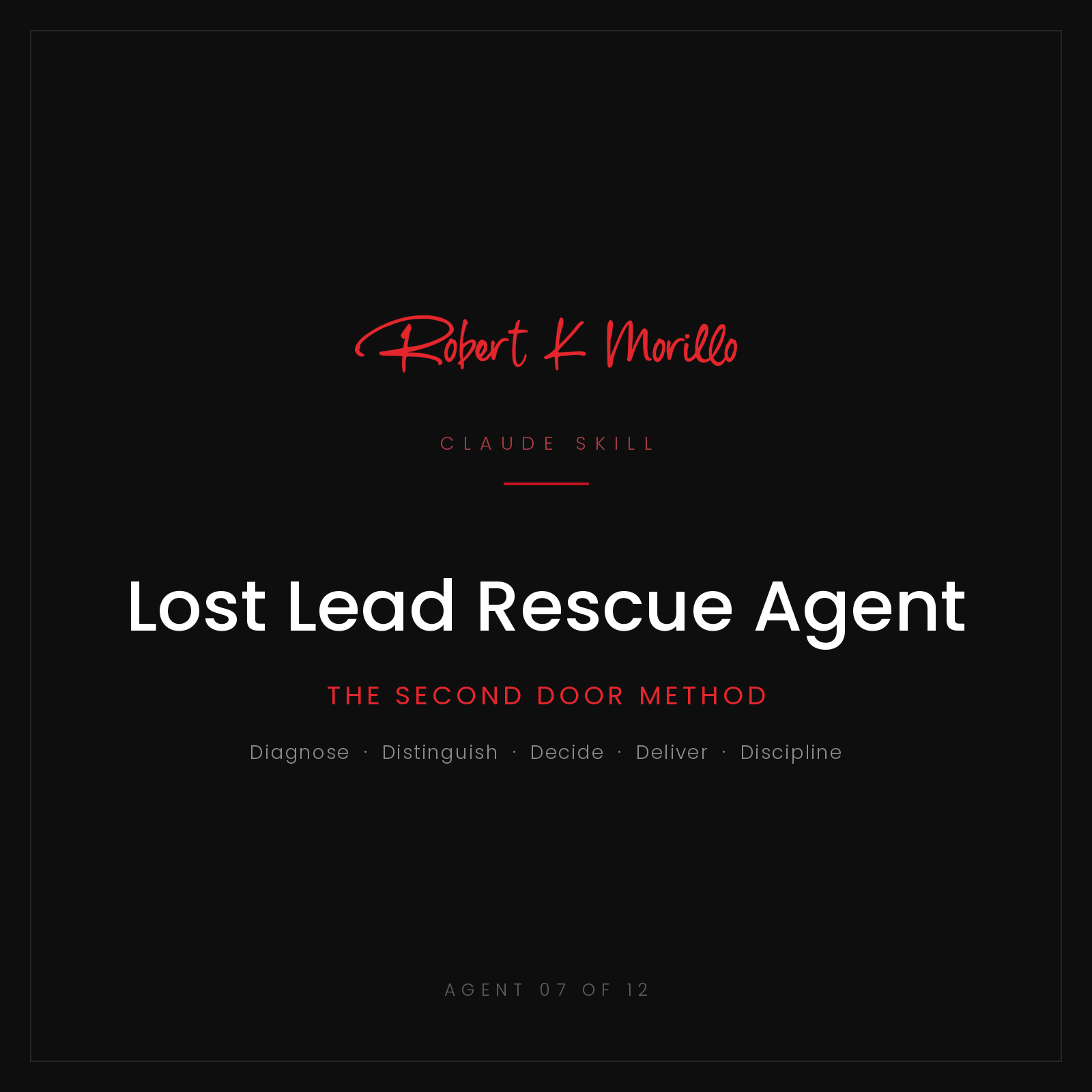
Lost Lead Rescue Agent — Claude Skill
Bring Back The Deals You Already Lost, One At A Time
Every dead lead died of something specific, and the cause dictates the cure. A prospect who vanished mid-process needs the opposite of what a prospect who said no needs, and both need the opposite of what a prospect who signed with a competitor needs.
The Lost Lead Rescue Agent is a structured Claude Skill that spends most of its effort on diagnosis, because that is where recovery is actually won or lost. Send all three the same re-engagement message and it lands as tone-deaf to at least two of them.
WHO THIS IS FOR
The agent with a folder of buyers who toured three houses and then vanished.
The loan officer holding pre-approvals that went stale because nobody called back.
The business owner whose proposal got a “we’re reviewing internally” five months ago and nothing since.
WHAT IT DOES
You hand it the wreckage. A closed-lost export, a pipeline report, a text thread, a call transcript, or just one name and the story of how it fell apart. Most dead leads have almost no notes. That’s the normal case, and it works from there.
Then it runs five moves.
IT DIAGNOSES. Every dead lead died of something specific, and it gets exactly one cause: ghosted, rejected, lost to a competitor, or stalled by circumstance. Each cause needs the opposite message from the other three. A single re-engagement template sent to all four reads as tone-deaf to at least three of them, which is why most of these campaigns quietly fail. You also get a confidence level on each one — confirmed, inferred, or undetermined. Undetermined is an honest answer, and it says so instead of guessing to make the table look full.
IT RUNS THE LAST-MESSAGE TEST. This is the whole thing. Open the thread and look at who sent the final message. If it was you and they never answered, the lead ghosted you. If it was them and you never answered, you ghosted the lead. That’s a completely different diagnosis, it’s far more common than anyone records, and it’s the most recoverable lead in your entire file — because they were still engaged when the contact stopped. Salespeople almost never write down their own drops. This checks every single thread before it accepts a ghost. One question, and it reorganizes your whole dead-lead pile.
IT SEPARATES THE POLITE REASON FROM THE REAL ONE. The recorded reason is what someone said to end the conversation gracefully. “Bad timing” is usually price. “Need to think about it” is usually a decision maker who was never in the room. “Went another direction” is usually that somebody else answered faster. It reads transcripts for the moment the energy changed, not the moment the call ended, and those are usually several minutes apart. Re-entry aimed at the polite reason solves a problem that was never real.
IT DECIDES WHO TO LEAVE ALONE. Every lead gets one of three verdicts: re-enter now, hold until a named trigger, or close permanently. Opt-outs, hostile endings, anyone under an active representation agreement or in process with another provider, service failures you haven’t fixed — those get named and taken off your plate. A folder of 80 that comes back as 22 re-entries, 41 dated holds, and 17 permanent closes is a working plan. Eighty messages is a liability.
IT WRITES AND IT DISCIPLINES. One message per lead, in the channel the relationship actually lived on, replying inside the original thread wherever one exists. For ghosted leads it uses the accountability opener, which is the highest-performing re-entry here and almost nobody uses it: one sentence taking the drop, no explanation, no ask, and an easy exit. Someone who ghosted you is carrying low-grade guilt, and “just checking in” asks them to resolve that guilt before they can reply — so they don’t. Then it caps the attempts. Two for a ghost, one for a rejection. Dead leads are not a nurture pool, and volume is what most of them are recovering from.
PRIMARY RESULT
Live conversations pulled out of deals you already wrote off.
Here’s the honest part. Roughly 15% to 25% of well-diagnosed ghosted leads reply, and rejections and competitor losses come back in the low single digits. A folder of 100 dead leads worked properly returns a handful of real conversations, not dozens. The compounding value isn’t in the first wave — it’s in the hold calendar, months out, and only for the people who wrote the date down.
WHAT YOU’LL ACTUALLY GET BACK
A diagnosis table — every lead, its cause of death, the confidence level, and the evidence that decided it.
An operative-reason column showing where the real reason differs from the recorded one, and why.
A decision list with counts: re-enter now, hold until trigger, close permanently.
Ready-to-send re-entry messages for the re-enter-now group only, one per lead.
A hold calendar, each lead with the specific event to watch for, not a vague date range.
A named closed-permanently list, with reasons, so you stop spending attention there.
A tracking table built around the two columns that keep this alive: next action, and next action date.
HOW TO INSTALL IT
Before you start, you’ll need a paid Claude account (Pro, Max, Team, or Enterprise) with code execution enabled in your settings. Custom skills aren’t available on the free plan.
Step 1 — Download the .skill file from your confirmation email.
Step 2 — Open Claude and go to Settings, then Capabilities.
Step 3 — Upload the file.
Step 4 — Start a new conversation and describe your task in plain language — “this buyer went dark on me in March, what do I say?” The agent activates on its own when the work matches. You don’t have to call it by name.
Installed skills live on your individual account, not your whole organization. If you have a team, each person installs their own copy.
Written for people already working inside Claude. If you get stuck, reply to your confirmation email — we’ll walk you through it.
BEST PRACTICES
Answer three questions when the notes are thin. What was the last thing that actually happened, who sent the last message, and what did they say at the very end in their own words. Question two alone sorts more leads correctly than any CRM field you own.
Give it the thread, not the disposition. Disposition fields are picklist values someone chose to close a task, and “not interested” is the default escape hatch in most systems. A free-text note reading “seemed weird about the price” outranks every clean column in the export.
Check public record before you diagnose a ghost. Silence after a proposal often means they signed elsewhere. A buyer who went quiet may have already bought with another agent. Verify first, because an accountability opener sent to someone who chose a competitor is embarrassing.
Send the graceful close. Ten to fourteen days after the opener, name the silence, give them permission to be done, and stop. It gets the highest reply rate in the sequence, and it works only because it’s genuinely the last message. Follow it with another touch and it turns manipulative, and people notice.
Move fast on the ones you dropped. When the last unanswered message is theirs, re-enter now. Every additional week weakens the apology and dulls the memory that makes it specific.
Put the change in the first line of a rejection message. Nothing changed means nothing to send. Time alone is not a reason, and re-pitching the same offer to someone who already declined gets the same answer.
Do not fish after a competitor loss. “What made you go the other way?” turns your prospect into your unpaid consultant and earns a polite non-answer. Congratulate them, ask once to be the second call, then put a note on your calendar 60 to 90 days before their renewal. That date is where the money actually is.
WHAT THIS IS NOT
This is not database reactivation. Reactivation works a whole list by tier and recency. This works individual failed deals by cause of death, and it spends most of its effort on diagnosis, because that’s where recovery is won or lost. If you want a Top 25 to call this week, buy the other one.
It also will not hand you a message for every name you give it. Opt-outs, hostile endings, unfixed service failures, bereavements, and anyone currently under an active representation agreement or in process with another provider go on a permanent-close list and stay there. That last one isn’t a courtesy question — it’s interference and procuring-cause exposure, and unknown status gets treated as active. Expect to get back fewer leads than you handed over. That shorter list is the work.
PRICE
$197 individually.
Or get all 12 agents in the full library for $697 — including every agent added after you buy. That’s less than the price of four bought separately.
The $697 is a founding price. It goes to $997 once the first ten buyers send back documented results — no timer, no countdown, just an honest discount for buying before there’s proof.
Most of the deals you think died on you actually died on silence, and half the time the silence was yours. There’s a second door on almost every one of them, and it opens the same way every time: tell the truth about what happened, and give them an easy way out.
Start with the ones you dropped.
Bring Back The Deals You Already Lost, One At A Time
Every dead lead died of something specific, and the cause dictates the cure. A prospect who vanished mid-process needs the opposite of what a prospect who said no needs, and both need the opposite of what a prospect who signed with a competitor needs.
The Lost Lead Rescue Agent is a structured Claude Skill that spends most of its effort on diagnosis, because that is where recovery is actually won or lost. Send all three the same re-engagement message and it lands as tone-deaf to at least two of them.
WHO THIS IS FOR
The agent with a folder of buyers who toured three houses and then vanished.
The loan officer holding pre-approvals that went stale because nobody called back.
The business owner whose proposal got a “we’re reviewing internally” five months ago and nothing since.
WHAT IT DOES
You hand it the wreckage. A closed-lost export, a pipeline report, a text thread, a call transcript, or just one name and the story of how it fell apart. Most dead leads have almost no notes. That’s the normal case, and it works from there.
Then it runs five moves.
IT DIAGNOSES. Every dead lead died of something specific, and it gets exactly one cause: ghosted, rejected, lost to a competitor, or stalled by circumstance. Each cause needs the opposite message from the other three. A single re-engagement template sent to all four reads as tone-deaf to at least three of them, which is why most of these campaigns quietly fail. You also get a confidence level on each one — confirmed, inferred, or undetermined. Undetermined is an honest answer, and it says so instead of guessing to make the table look full.
IT RUNS THE LAST-MESSAGE TEST. This is the whole thing. Open the thread and look at who sent the final message. If it was you and they never answered, the lead ghosted you. If it was them and you never answered, you ghosted the lead. That’s a completely different diagnosis, it’s far more common than anyone records, and it’s the most recoverable lead in your entire file — because they were still engaged when the contact stopped. Salespeople almost never write down their own drops. This checks every single thread before it accepts a ghost. One question, and it reorganizes your whole dead-lead pile.
IT SEPARATES THE POLITE REASON FROM THE REAL ONE. The recorded reason is what someone said to end the conversation gracefully. “Bad timing” is usually price. “Need to think about it” is usually a decision maker who was never in the room. “Went another direction” is usually that somebody else answered faster. It reads transcripts for the moment the energy changed, not the moment the call ended, and those are usually several minutes apart. Re-entry aimed at the polite reason solves a problem that was never real.
IT DECIDES WHO TO LEAVE ALONE. Every lead gets one of three verdicts: re-enter now, hold until a named trigger, or close permanently. Opt-outs, hostile endings, anyone under an active representation agreement or in process with another provider, service failures you haven’t fixed — those get named and taken off your plate. A folder of 80 that comes back as 22 re-entries, 41 dated holds, and 17 permanent closes is a working plan. Eighty messages is a liability.
IT WRITES AND IT DISCIPLINES. One message per lead, in the channel the relationship actually lived on, replying inside the original thread wherever one exists. For ghosted leads it uses the accountability opener, which is the highest-performing re-entry here and almost nobody uses it: one sentence taking the drop, no explanation, no ask, and an easy exit. Someone who ghosted you is carrying low-grade guilt, and “just checking in” asks them to resolve that guilt before they can reply — so they don’t. Then it caps the attempts. Two for a ghost, one for a rejection. Dead leads are not a nurture pool, and volume is what most of them are recovering from.
PRIMARY RESULT
Live conversations pulled out of deals you already wrote off.
Here’s the honest part. Roughly 15% to 25% of well-diagnosed ghosted leads reply, and rejections and competitor losses come back in the low single digits. A folder of 100 dead leads worked properly returns a handful of real conversations, not dozens. The compounding value isn’t in the first wave — it’s in the hold calendar, months out, and only for the people who wrote the date down.
WHAT YOU’LL ACTUALLY GET BACK
A diagnosis table — every lead, its cause of death, the confidence level, and the evidence that decided it.
An operative-reason column showing where the real reason differs from the recorded one, and why.
A decision list with counts: re-enter now, hold until trigger, close permanently.
Ready-to-send re-entry messages for the re-enter-now group only, one per lead.
A hold calendar, each lead with the specific event to watch for, not a vague date range.
A named closed-permanently list, with reasons, so you stop spending attention there.
A tracking table built around the two columns that keep this alive: next action, and next action date.
HOW TO INSTALL IT
Before you start, you’ll need a paid Claude account (Pro, Max, Team, or Enterprise) with code execution enabled in your settings. Custom skills aren’t available on the free plan.
Step 1 — Download the .skill file from your confirmation email.
Step 2 — Open Claude and go to Settings, then Capabilities.
Step 3 — Upload the file.
Step 4 — Start a new conversation and describe your task in plain language — “this buyer went dark on me in March, what do I say?” The agent activates on its own when the work matches. You don’t have to call it by name.
Installed skills live on your individual account, not your whole organization. If you have a team, each person installs their own copy.
Written for people already working inside Claude. If you get stuck, reply to your confirmation email — we’ll walk you through it.
BEST PRACTICES
Answer three questions when the notes are thin. What was the last thing that actually happened, who sent the last message, and what did they say at the very end in their own words. Question two alone sorts more leads correctly than any CRM field you own.
Give it the thread, not the disposition. Disposition fields are picklist values someone chose to close a task, and “not interested” is the default escape hatch in most systems. A free-text note reading “seemed weird about the price” outranks every clean column in the export.
Check public record before you diagnose a ghost. Silence after a proposal often means they signed elsewhere. A buyer who went quiet may have already bought with another agent. Verify first, because an accountability opener sent to someone who chose a competitor is embarrassing.
Send the graceful close. Ten to fourteen days after the opener, name the silence, give them permission to be done, and stop. It gets the highest reply rate in the sequence, and it works only because it’s genuinely the last message. Follow it with another touch and it turns manipulative, and people notice.
Move fast on the ones you dropped. When the last unanswered message is theirs, re-enter now. Every additional week weakens the apology and dulls the memory that makes it specific.
Put the change in the first line of a rejection message. Nothing changed means nothing to send. Time alone is not a reason, and re-pitching the same offer to someone who already declined gets the same answer.
Do not fish after a competitor loss. “What made you go the other way?” turns your prospect into your unpaid consultant and earns a polite non-answer. Congratulate them, ask once to be the second call, then put a note on your calendar 60 to 90 days before their renewal. That date is where the money actually is.
WHAT THIS IS NOT
This is not database reactivation. Reactivation works a whole list by tier and recency. This works individual failed deals by cause of death, and it spends most of its effort on diagnosis, because that’s where recovery is won or lost. If you want a Top 25 to call this week, buy the other one.
It also will not hand you a message for every name you give it. Opt-outs, hostile endings, unfixed service failures, bereavements, and anyone currently under an active representation agreement or in process with another provider go on a permanent-close list and stay there. That last one isn’t a courtesy question — it’s interference and procuring-cause exposure, and unknown status gets treated as active. Expect to get back fewer leads than you handed over. That shorter list is the work.
PRICE
$197 individually.
Or get all 12 agents in the full library for $697 — including every agent added after you buy. That’s less than the price of four bought separately.
The $697 is a founding price. It goes to $997 once the first ten buyers send back documented results — no timer, no countdown, just an honest discount for buying before there’s proof.
Most of the deals you think died on you actually died on silence, and half the time the silence was yours. There’s a second door on almost every one of them, and it opens the same way every time: tell the truth about what happened, and give them an easy way out.
Start with the ones you dropped.