 Image 1 of 1
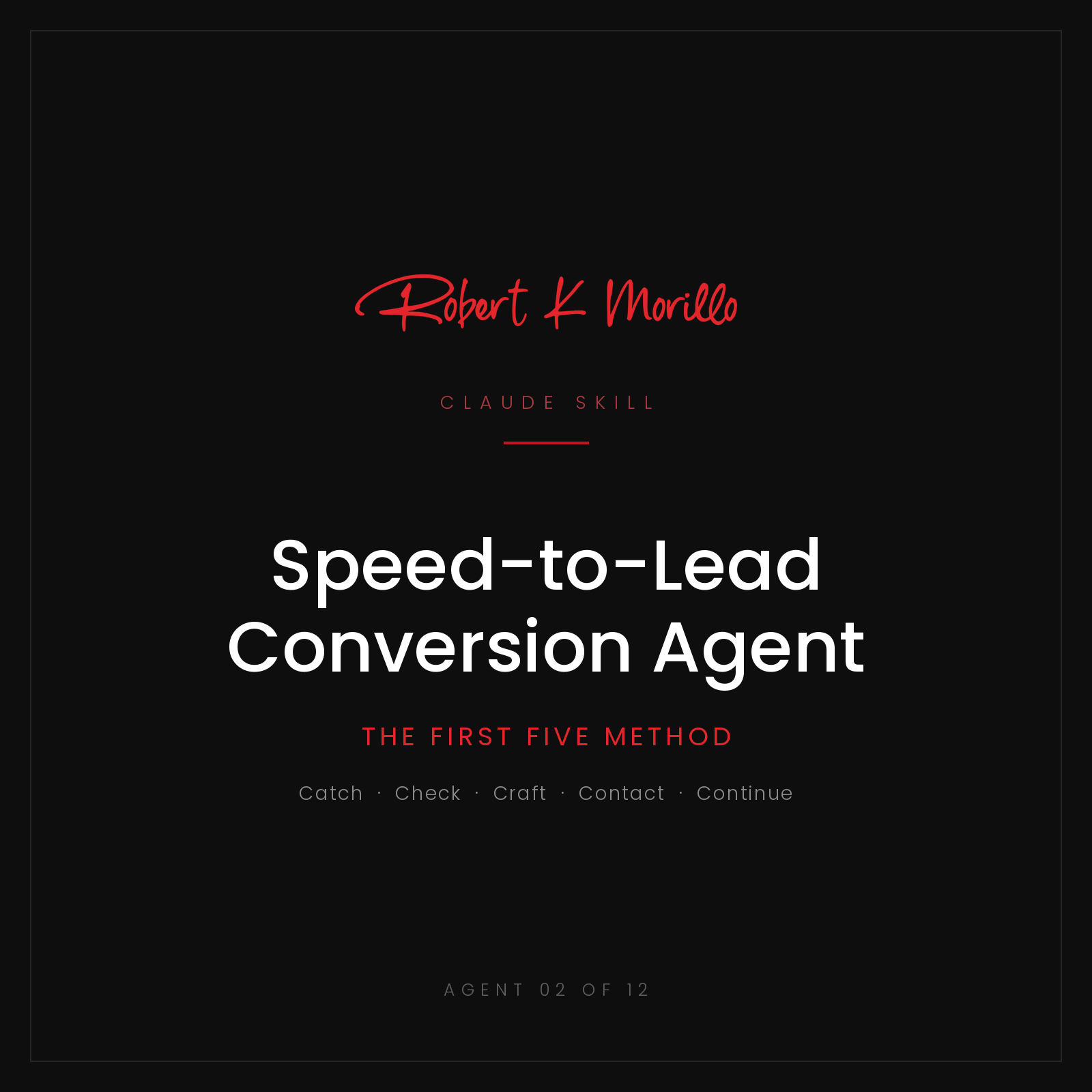
Speed-to-Lead Conversion Agent — Claude Skill
Turn New Inquiries Into Live Conversations Before Your Competition Answers
Most inbound leads aren’t lost to a weak pitch. They’re lost to a reply that arrived four hours late, addressed to a stranger, asking a question nobody wants to answer in writing.
The Speed-to-Lead Conversion Agent is a structured Claude Skill that closes that gap. Contact odds fall off sharply between five minutes and thirty, and off a cliff after a day. This one gets your first response ready to send in under two minutes.
WHO THIS IS FOR
The agent who watched a portal lead land at 9pm and answered it at noon the next day.
The loan officer racing four other lenders for the same rate-table lead, every single time.
The business owner whose form fills sit in an inbox nobody opens until Tuesday.
WHAT IT DOES
You hand it the inquiry exactly as it showed up. A pasted form notification, a forwarded email, a screenshot of a text, a voicemail transcript, a name and a phone number and nothing else. It works with a thin lead, because most real leads are thin.
Then it runs five moves.
IT TRIAGES. The channel tells you almost everything before you read a word. A missed call is the highest-intent lead you will get all week. A portal lead may not even remember submitting. Each one gets its own clock and its own opening. It also flags the junk early — fake names, disposable domains, three submissions in four minutes — so you don’t run a fourteen-day sequence into a void.
IT DOES THE HOMEWORK, THEN STOPS. Ninety seconds, spent in order. Your own records first, then the listing or page they asked about, then a quick sanity check on the identity. Past ninety seconds the delay costs more than the personalization gains. Everything found runs through one filter before it can be used — could you say out loud how you know this, in one sentence, without sounding like surveillance? What fails that test can still shape the question. It never becomes a statement.
IT WRITES FOR A REPLY, NOT A SALE. This is where most first responses die. They answer the question so completely that nothing is left to respond to. Every draft here names the exact thing they asked about in the first line, carries one question answerable in under five words, and asks nothing about budget, credit, or timeline. Six checks run before you see it. Anything that fails gets rewritten. Anywhere your data was too thin, it marks the gap instead of inventing a detail.
IT GETS IT DELIVERED. Text first, call a minute later, voicemail only after the text has gone out — the text is what explains the unknown number that’s about to ring. Quiet hours are respected in their time zone, not yours. Leads that land at 11pm get an honest automatic acknowledgement now, a real human message at the opening of the window, and front of the queue in the morning.
IT KEEPS GOING AFTER TOUCH TWO. A 14-day sequence, 8 to 12 attempts, front-loaded into the first 72 hours, spread across text, call, email, and DM with the actual copy for each step. Qualifying questions arrive one per exchange, each earned by something the lead just said. Stop rules on every channel. A recycle path at 30 and 90 days for the people who never answer, because unproven is not the same as dead.
PRIMARY RESULT
Leads that answer, because you got there first.
Here’s the honest part. One or two attempts contact roughly one lead in four. A disciplined 14-day sequence moves that to roughly one in three. It does not move it to four in five, and 60 to 70 percent of inbound leads never reply to anyone, no matter who’s working them. The gain lives in two places — cutting your first response from hours to minutes, and still being there at touch eight when everyone else quit at touch one. Both are big. Neither is magic.
WHAT YOU’LL ACTUALLY GET BACK
A lead snapshot — who they are, which channel, what they asked, what time it landed, and what’s missing or suspect.
A four-line research brief, with every unverified detail marked [CONFIRM: …] so you fill it instead of guessing.
The first response in every channel that applies — text, short email, 20-second voicemail script, and a DM version when the lead came from social.
A qualifying ladder mapped to exchanges, so you know which question belongs at reply one and which one waits until reply five.
A 14-day sequence grid with the day, the channel, and the written message for all 8 to 12 steps, including the day-14 graceful close.
A one-line tracking row you can paste straight into your CRM — source, first-touch time, attempts, last touch, next action, next action date.
The constraints that apply to this specific lead, named plainly before you send anything.
HOW TO INSTALL IT
Before you start, you’ll need a paid Claude account (Pro, Max, Team, or Enterprise) with code execution enabled in your settings. Custom skills aren’t available on the free plan.
Step 1 — Download the .skill file from your confirmation email.
Step 2 — Open Claude and go to Settings, then Capabilities.
Step 3 — Upload the file.
Step 4 — Start a new conversation and describe your task in plain language — “just got this lead off Zillow, what do I send?” The agent activates on its own when the work matches. You don’t have to call it by name.
Installed skills live on your individual account, not your whole organization. If you have a team, each person installs their own copy.
Written for people already working inside Claude. If you get stuck, reply to your confirmation email — we’ll walk you through it.
BEST PRACTICES
Send the good-enough message in three minutes. A B-plus text sent now beats an excellent one sent in forty minutes, and it isn’t close. Speed only stops mattering the second they reply. Then quality takes over completely.
Pair the text with the call, always. A text plus a call on the same first attempt outperforms either one alone, because the text is what explains the strange number lighting up their phone. Text first, call within a minute.
Ask one question, and make it small. Two questions get one answer, usually the easier one. If it can’t be answered in five words while they’re standing in a parking lot, it’s the wrong question for touch one.
Hold the money questions until exchange five. Budget, credit, and timeline in the first message read as a screening form, and a stranger asked about budget in writing will lowball or deflect. Let them describe their problem in their own words first. Then they’ll talk about money.
Work weekend leads on the weekend. A Sunday inquiry answered Monday is usually already someone else’s client. Weekend leads in real estate are the strongest of the week, not the weakest.
Fill in every [CONFIRM] before you hit send. When your inquiry was too thin to personalize honestly, it marks the gap rather than guessing. A wrong specific is worse than a generic message, because it proves nobody read the inquiry.
Do not let an automated step fire after someone has already replied. That’s the one failure this workflow can’t recover from. Verify the stop rules before you load any sequence into a platform, not after.
WHAT THIS IS NOT
This is not a sending platform and it does not touch your CRM. It hands you the triage, the words, the timing, and the sequence. You still hit send, and you still pick up the phone.
It also has nothing to offer a purchased cold list or a lead from eight months ago. This covers the first fourteen days after someone raises their hand. Past 90 days you don’t have a speed problem, you have a database problem, and that’s a different agent.
PRICE
$197 individually.
Or get all 12 agents in the full library for $697 — including every agent added after you buy. That’s less than the price of four bought separately.
The $697 is a founding price. It goes to $997 once the first ten buyers send back documented results — no timer, no countdown, just an honest discount for buying before there’s proof.
Most leads aren’t lost on the pitch. They’re lost in the four hours between when they reached out and when you finally got back to them.
Answer the next one in five minutes and watch what changes.
Turn New Inquiries Into Live Conversations Before Your Competition Answers
Most inbound leads aren’t lost to a weak pitch. They’re lost to a reply that arrived four hours late, addressed to a stranger, asking a question nobody wants to answer in writing.
The Speed-to-Lead Conversion Agent is a structured Claude Skill that closes that gap. Contact odds fall off sharply between five minutes and thirty, and off a cliff after a day. This one gets your first response ready to send in under two minutes.
WHO THIS IS FOR
The agent who watched a portal lead land at 9pm and answered it at noon the next day.
The loan officer racing four other lenders for the same rate-table lead, every single time.
The business owner whose form fills sit in an inbox nobody opens until Tuesday.
WHAT IT DOES
You hand it the inquiry exactly as it showed up. A pasted form notification, a forwarded email, a screenshot of a text, a voicemail transcript, a name and a phone number and nothing else. It works with a thin lead, because most real leads are thin.
Then it runs five moves.
IT TRIAGES. The channel tells you almost everything before you read a word. A missed call is the highest-intent lead you will get all week. A portal lead may not even remember submitting. Each one gets its own clock and its own opening. It also flags the junk early — fake names, disposable domains, three submissions in four minutes — so you don’t run a fourteen-day sequence into a void.
IT DOES THE HOMEWORK, THEN STOPS. Ninety seconds, spent in order. Your own records first, then the listing or page they asked about, then a quick sanity check on the identity. Past ninety seconds the delay costs more than the personalization gains. Everything found runs through one filter before it can be used — could you say out loud how you know this, in one sentence, without sounding like surveillance? What fails that test can still shape the question. It never becomes a statement.
IT WRITES FOR A REPLY, NOT A SALE. This is where most first responses die. They answer the question so completely that nothing is left to respond to. Every draft here names the exact thing they asked about in the first line, carries one question answerable in under five words, and asks nothing about budget, credit, or timeline. Six checks run before you see it. Anything that fails gets rewritten. Anywhere your data was too thin, it marks the gap instead of inventing a detail.
IT GETS IT DELIVERED. Text first, call a minute later, voicemail only after the text has gone out — the text is what explains the unknown number that’s about to ring. Quiet hours are respected in their time zone, not yours. Leads that land at 11pm get an honest automatic acknowledgement now, a real human message at the opening of the window, and front of the queue in the morning.
IT KEEPS GOING AFTER TOUCH TWO. A 14-day sequence, 8 to 12 attempts, front-loaded into the first 72 hours, spread across text, call, email, and DM with the actual copy for each step. Qualifying questions arrive one per exchange, each earned by something the lead just said. Stop rules on every channel. A recycle path at 30 and 90 days for the people who never answer, because unproven is not the same as dead.
PRIMARY RESULT
Leads that answer, because you got there first.
Here’s the honest part. One or two attempts contact roughly one lead in four. A disciplined 14-day sequence moves that to roughly one in three. It does not move it to four in five, and 60 to 70 percent of inbound leads never reply to anyone, no matter who’s working them. The gain lives in two places — cutting your first response from hours to minutes, and still being there at touch eight when everyone else quit at touch one. Both are big. Neither is magic.
WHAT YOU’LL ACTUALLY GET BACK
A lead snapshot — who they are, which channel, what they asked, what time it landed, and what’s missing or suspect.
A four-line research brief, with every unverified detail marked [CONFIRM: …] so you fill it instead of guessing.
The first response in every channel that applies — text, short email, 20-second voicemail script, and a DM version when the lead came from social.
A qualifying ladder mapped to exchanges, so you know which question belongs at reply one and which one waits until reply five.
A 14-day sequence grid with the day, the channel, and the written message for all 8 to 12 steps, including the day-14 graceful close.
A one-line tracking row you can paste straight into your CRM — source, first-touch time, attempts, last touch, next action, next action date.
The constraints that apply to this specific lead, named plainly before you send anything.
HOW TO INSTALL IT
Before you start, you’ll need a paid Claude account (Pro, Max, Team, or Enterprise) with code execution enabled in your settings. Custom skills aren’t available on the free plan.
Step 1 — Download the .skill file from your confirmation email.
Step 2 — Open Claude and go to Settings, then Capabilities.
Step 3 — Upload the file.
Step 4 — Start a new conversation and describe your task in plain language — “just got this lead off Zillow, what do I send?” The agent activates on its own when the work matches. You don’t have to call it by name.
Installed skills live on your individual account, not your whole organization. If you have a team, each person installs their own copy.
Written for people already working inside Claude. If you get stuck, reply to your confirmation email — we’ll walk you through it.
BEST PRACTICES
Send the good-enough message in three minutes. A B-plus text sent now beats an excellent one sent in forty minutes, and it isn’t close. Speed only stops mattering the second they reply. Then quality takes over completely.
Pair the text with the call, always. A text plus a call on the same first attempt outperforms either one alone, because the text is what explains the strange number lighting up their phone. Text first, call within a minute.
Ask one question, and make it small. Two questions get one answer, usually the easier one. If it can’t be answered in five words while they’re standing in a parking lot, it’s the wrong question for touch one.
Hold the money questions until exchange five. Budget, credit, and timeline in the first message read as a screening form, and a stranger asked about budget in writing will lowball or deflect. Let them describe their problem in their own words first. Then they’ll talk about money.
Work weekend leads on the weekend. A Sunday inquiry answered Monday is usually already someone else’s client. Weekend leads in real estate are the strongest of the week, not the weakest.
Fill in every [CONFIRM] before you hit send. When your inquiry was too thin to personalize honestly, it marks the gap rather than guessing. A wrong specific is worse than a generic message, because it proves nobody read the inquiry.
Do not let an automated step fire after someone has already replied. That’s the one failure this workflow can’t recover from. Verify the stop rules before you load any sequence into a platform, not after.
WHAT THIS IS NOT
This is not a sending platform and it does not touch your CRM. It hands you the triage, the words, the timing, and the sequence. You still hit send, and you still pick up the phone.
It also has nothing to offer a purchased cold list or a lead from eight months ago. This covers the first fourteen days after someone raises their hand. Past 90 days you don’t have a speed problem, you have a database problem, and that’s a different agent.
PRICE
$197 individually.
Or get all 12 agents in the full library for $697 — including every agent added after you buy. That’s less than the price of four bought separately.
The $697 is a founding price. It goes to $997 once the first ten buyers send back documented results — no timer, no countdown, just an honest discount for buying before there’s proof.
Most leads aren’t lost on the pitch. They’re lost in the four hours between when they reached out and when you finally got back to them.
Answer the next one in five minutes and watch what changes.